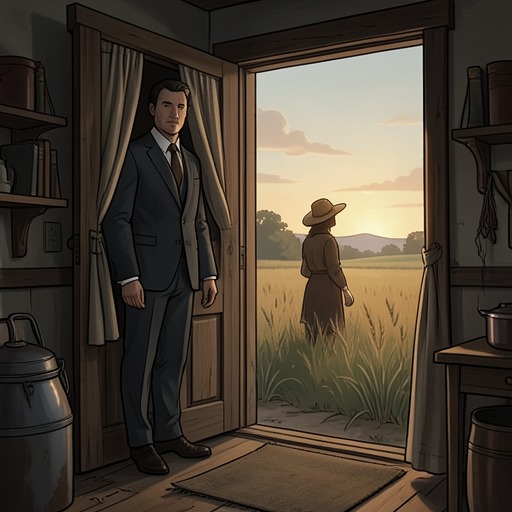
W. W. Vaughan killing after investigating the murders
Killers of the Flower MoonW. W. Vaughan’s killing silenced a man who had gathered evidence against William K. Hale and left his family with both a devastating loss and an unanswered question: who had arranged his death? Decades later, records and testimony would place H. G. Burt on Vaughan’s final train journey and strengthen suspicions about Hale’s network. But the manner of the killing, the identity of the person who carried it out, and the full extent of any conspiracy remained unresolved.
Investigation and the threat
Shortly before he was killed, Vaughan told his wife that he had collected enough evidence to put William K. Hale in the electric chair. Family members also remembered that Vaughan had hidden evidence about the murders, along with money intended for his family. The combination made his death consequential beyond the loss of an investigator: whatever he had collected might have exposed the people behind the killings, and its whereabouts became part of the mystery.
The family’s account left two possible explanations for how the hidden material was discovered. Vaughan might have been forced to reveal the hiding place before he was thrown from the train, or he might have confided in someone he trusted. Neither possibility could be established. The question remained especially troubling because Vaughan was described as big and strong; his relatives reasoned that whoever subdued him would have needed considerable physical strength or help from accomplices.
The train and the unanswered inquest
Vaughan disappeared from his berth during a train journey. A newspaper account later found by the book’s narrator established that Burt had boarded the train with Vaughan in Oklahoma City and was aboard during the journey. Another newspaper story reported that Burt himself notified others of Vaughan’s disappearance. These facts put Burt close to the final known circumstances of Vaughan’s life, but they did not establish what happened in the berth or who was responsible.
The precise sequence of death and disposal was never clarified. Vaughan’s family wondered whether he had been killed before being thrown from the train or whether the impact had killed him. They believed that someone influential ensured that the inquest was a sham; the official cause of death was recorded as unknown. A family archive assembled over decades preserved the unanswered questions in tangible form: two thick binders containing faded newspaper clippings, Vaughan’s death certificate, and an informant’s statement about his evidence against Hale.
Burt, Hale, and the circumstantial case
Later research gave the suspicions a wider context. A trusted informant told investigators that Burt and Hale were very close associates and had shared money obtained from George Bigheart. After Bigheart’s death, Hale claimed six thousand dollars from his estate by presenting a fraudulent creditor’s note; Burt, meanwhile, had tried to take ten thousand dollars. The records did not establish that these sums supplied a motive for Vaughan’s murder, but they showed Burt and Hale connected through money and through the exploitation under investigation.
The financial trail also touched Vaughan directly. Court records showed that Burt had taken money Bigheart intended for Vaughan, despite presenting himself as Vaughan’s close friend. Vaughan’s relatives later recalled that an unnamed man had embezzled money from his estate, prompting his widow, Rosa, to sue in civil court. When the narrator raised that episode, Martha Vaughan remembered the name only as something like Burt. That recollection did not prove Burt had killed Vaughan, but it sharpened the significance of the archival evidence.
An informant who had been close to Hale and had supplied evidence in other murder cases later identified Burt as the person he thought had carried out Vaughan’s killing. Notes from an unpublished interview with the Fairfax town marshal offered a separate, still uncorroborated account: the marshal implicated Burt and said that a local mayor had helped throw Vaughan from the train. He also reported that Burt had been frightened during the bureau’s 1925 investigation and considered fleeing; Burt moved to Kansas that year. These allegations added a possible accomplice and a possible reason for flight, but they did not turn suspicion into a proven account of the murder.
Family loss and enforced silence
Vaughan’s widow, Rosa, was left to raise ten children without income. The family had to leave its two-story house and move into a storage garage; they struggled to afford food. Members of the Osage community helped feed them, and some of the children, including Martha’s father, lived with Osage families. They grew up speaking Osage and learning traditional dances. Martha later remembered that her father felt safe among the Osage.
The family’s search for an answer was itself met with intimidation. After Hale had gone to jail, a relative tried to continue investigating Vaughan’s death. An anonymous warning threatened that if the family pursued the matter, they would all end up like Vaughan. The investigation stopped. Years later, Martha recalled asking an older uncle who had killed their grandfather; he repeated the warning and remained frightened. The threat did not identify a killer, but it helps explain why family knowledge and suspicion could persist without developing into a public resolution.
What the evidence could not settle
When the narrator reviewed the records with Martha, he stressed the limits of what could be known. The case against Burt rested on circumstantial connections: his association with Hale, his financial dealings with Bigheart and Vaughan, his presence on the train, and the accusations preserved in informant and marshal accounts. No surviving account established exactly how Vaughan died or conclusively demonstrated who killed him. Martha fell silent and then began to sob as the evidence was recounted.
The killing thus remained both a suspected part of the wider Osage murder network and a warning about the limits of retrospective investigation. Vaughan’s death deprived his family of its provider and apparently removed evidence that might have implicated powerful men. The unresolved inquest, the threat to his relatives, and the uncertainty around his last journey all survived alongside the clues. They made his case more than a peripheral mystery: it exposed how violence, money, influence, and fear could frustrate the search for justice even when investigators and families had reason to suspect who stood behind it.